

Why Slugs and Beetles Belong on Dartford’s First Bear Trail
“Stop and look around you. Slow down. Discover things that are around you anyway.”
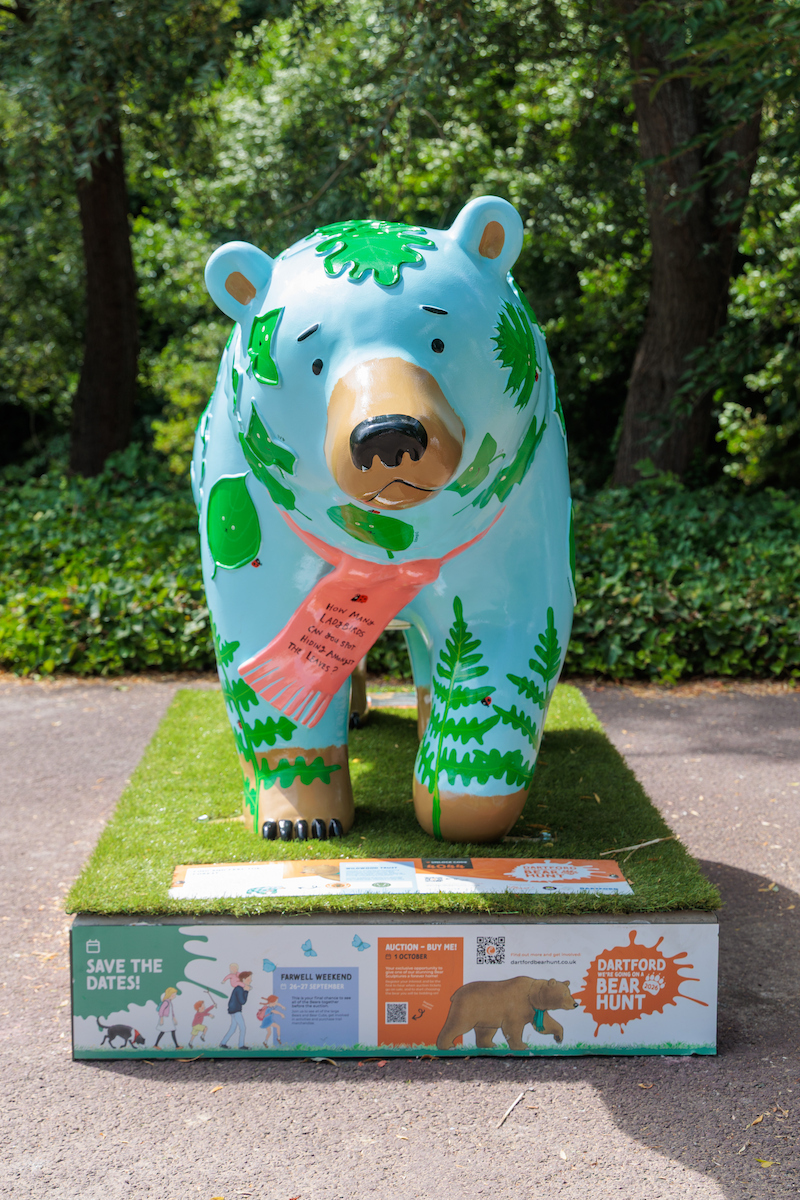
There’s a slug somewhere on Shona’s bear. Not one that reveals itself at first glance. You have to circle the sculpture slowly, letting its winding trail lead you towards a leaf, a raised texture, or some small detail you had not noticed before.
That is exactly what Shona intended.
Shona van Aswegen is one of the artists selected for ellenor’s We’re Going on a Bear Hunt art trail, a free public event running across the Borough of Dartford from 17 July to 13 September, with sculptures also appearing at Bluewater, the trail’s Official Partner. Led and delivered by ellenor, the project is presented with Dartford Borough Council and produced in partnership with Wild in Art, the internationally recognised creators of public art trails.
Inspired by the TV adaptation of We’re Going on a Bear Hunt, based on the picture book by Michael Rosen and Helen Oxenbury, the trail will bring together artists, schools, businesses and community groups while raising awareness of hospice care and vital funds for families across North Kent and Bexley.
Shona’s giant bear, sponsored by Wildwood Trust, is called Find and Feel the Forest.
As well as bringing colour and creativity to the borough, the trail will raise awareness of hospice care and the care and support ellenor provides to babies, children and adults living with life-limiting illnesses across North Kent and Bexley. It will also raise vital funds so that local families can continue to receive that care and support when they need it most.
“I want it to be something you explore,” she says. “Not just something you look at and walk past.”
Her world begins with the things many people overlook.
“Slugs, beetles, the things people might usually go ‘ugh’ at,” she says. “But they’re doing such important jobs.”
A slug, she explains, is “nature’s recycler, breaking things like leaves and fungi down and turning it into nutrient rich soil… making space for more life.”
That fascination grew alongside woodland walks with her children.
“We looked at all the little critters and beasties we discovered in the woods and grew to learn about all these little creatures,” she says. “They are fascinating, and I just want other people to appreciate them as well.”
There is humour in her work and warmth too, but also an invitation.
“Stop and look at things. Let yourself feel a bit of wonder.”
For Shona, the natural world is full of things that are easy to miss.
“Every little thing has a role” she says. “Even if you don’t like a slug crawling on your hand.”
Later, describing moss in the woods, she says: “A mini world can be happening… in a 30 centimetres square.”
Shona usually works in risograph print, a process that sits somewhere between digital and screen printing.
“It looks like a photocopier,” she says, “but it behaves more like screen printing.”
Layers are built up one colour at a time, often slightly misaligned, giving the work its distinctive texture and movement.
“You can’t always guarantee it’s going to land exactly where you expect,” she says. “That unpredictability and the vibrant colour is what gives it life.”
Taking that two-dimensional process and translating it onto the bear has meant working with layered colour and testing how those textures carry across a three-dimensional surface.
“I’ve been building up the leaves using epoxy putty,” she says. “It creates a raised outline that you can actually feel, so people can follow the shapes with their hands.”
She has also been sampling colours from her prints and testing how they translate onto the sculpture. Some areas are painted flat, while others use raised outlines. Details are added in a halftone style that mimics the inky pattern of risograph printing.
But Find and Feel the Forest is made to be felt as well as seen. Visitors will be able to feel leaves and follow the slug trail with their hands. Shona works with visually impaired and blind artists, so inclusion was built into the design from the start.
“It’s always in the back of my brain,” she says. “How can I make things more inclusive?”
And, she adds, that tactile element is not for one audience alone.
“If you’ve got 20/20 vision, you can still enjoy the touch element of it.”
The title reflects the way she hopes families will experience the bear together.
“I wanted it to feel really child-friendly and shared.”
Children may search for ladybirds or hidden details. Adults may recognise the shape of an oak leaf they have passed many times without naming.
“Can you find an oak leaf? With its distinctive curved shape?” she says. “You can have a conversation about nature.”
It is not about formal learning.
“Just learning through something that makes you smile.”
For Shona, part of the power of the trail is where it happens.
You might come across the bear in everyday places. People stop, take photos and interact.
That, Shona believes, is where public art can do something powerful.
“Joyful public art opens the door to meaningful conversations.”
For ellenor, those moments may begin with art, but they are also a chance to show that hospice care is not only about end of life. Support can begin from diagnosis and continue for however long it is needed, helping people and families live as fully as possible, for whatever lies ahead.
If the bear could speak, Shona thinks its message would be simple.
“Stop and look around you. Slow down. Discover things that are around you anyway.”
The invitation is there in the leaves, the textures, and the slow silver trail winding its way around the bear.
Pause for a moment and you may notice what was there all along.
When the trail opens this summer, come and explore it for yourself, helping raise awareness and vital funds so ellenor can continue supporting local families across North Kent and Bexley.
We’re going on an Art Hunt—are you coming?
Sign up for our newsletter to be the first to receive updates along the way!